Alliance UA CSO Hosts Its Own Panel at
HNPW in Geneva
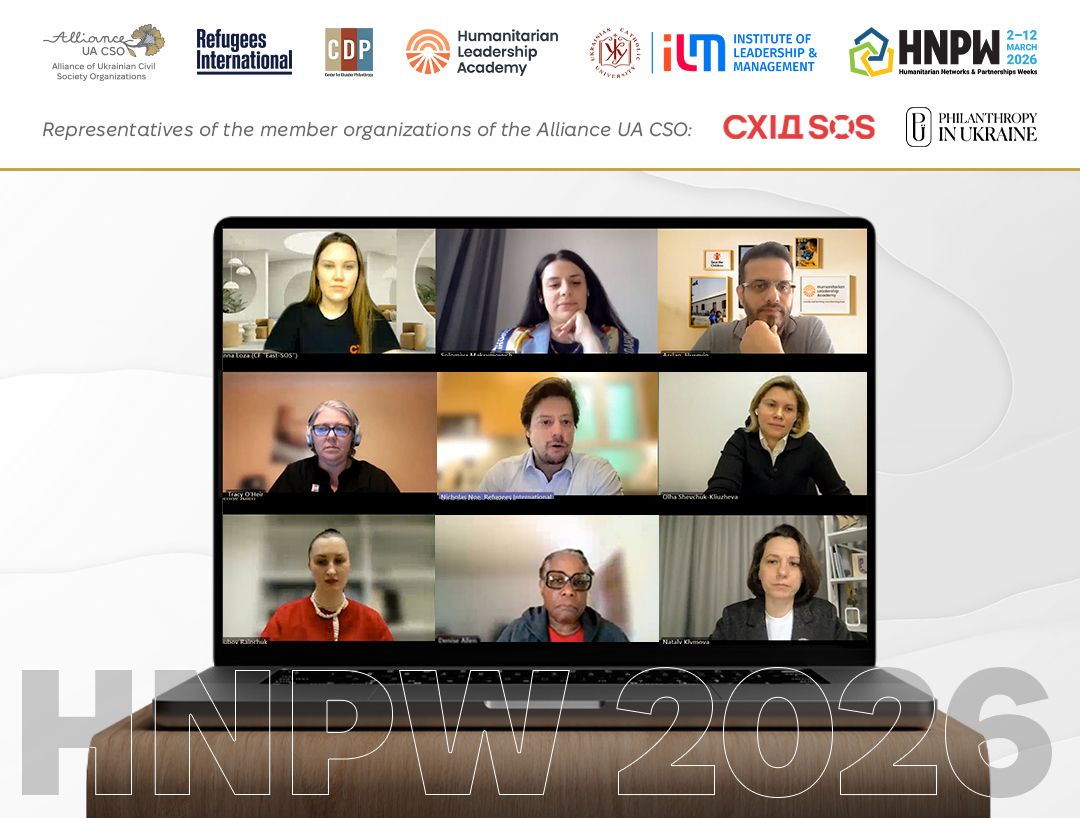
This year in Geneva, the Alliance of Ukrainian CSOs marked an important milestone by hosting its own panel at the Global Humanitarian Networks and Partnerships Week.
The discussion brought together sector leaders to address one of the critical challenges facing the humanitarian and civil society ecosystem today: how to move from scattered training sessions toward a cohesive system of leadership, institutional learning and long-term capacity.
The panel focused on the need to transform education and professional development in the humanitarian sector into a structured architecture of knowledge — one that preserves experience, strengthens organizations and supports Ukrainian leadership not only as a response to crisis, but as a model for the future.
Moderator
Nicholas Noe, Refugees International
Key Takeaways from the Discussion
Olha Shevchuk-Kliuzheva, Alliance UA CSO:
Localization is about professional autonomy. The Alliance is building a “critical infrastructure
of knowledge” where experience is not lost, but preserved, shared and scaled.
Solomiya Maksymovych, Institute of Leadership and Management, Ukrainian Catholic University:
Education is a space for reflection. The joint course with the Humanitarian Leadership Academy
and the Alliance connects academic depth with the real-world context of war.
Huseyin Arslan, Humanitarian Leadership Academy:
It is time to stop measuring success by the number of certificates. Real change requires
investment in governance and in the architecture of knowledge within organizations.
Liubov Rainchuk, Philanthropy in Ukraine:
The market is oversaturated with theory. The sector needs tailored programs for senior leadership,
supported by resources that allow organizations to put learning into practice.
Nataliia Klymova, ISAR Ednannia:
In February 2022, Ukrainians proved their capacity under fire. It is time to move beyond endless
“readiness assessments” and start trusting the national ecosystem.
Anna Loza, CF “East SOS”:
On the front lines, training is a matter of safety. Organizations need analytical tools and flexibility,
not ready-made templates from donors.
Tracy O’Heir, Center for Disaster Philanthropy:
Ukrainians should be supported as strategists, not only as implementers. The model being created
in Ukraine can become a benchmark for the wider humanitarian sector.
What Comes Next
Nicholas Noe concluded that the future of the sector depends on whether donors are ready to invest “upstream” — in systemic resilience, institutional learning and the integration of education through universities and long-term partnerships.
Localization is not just a slogan. It is an architecture of trust and leadership that we are building together.
We are grateful to our partners and colleagues for this strategic dialogue and for their commitment to strengthening Ukrainian leadership in the humanitarian sector.